
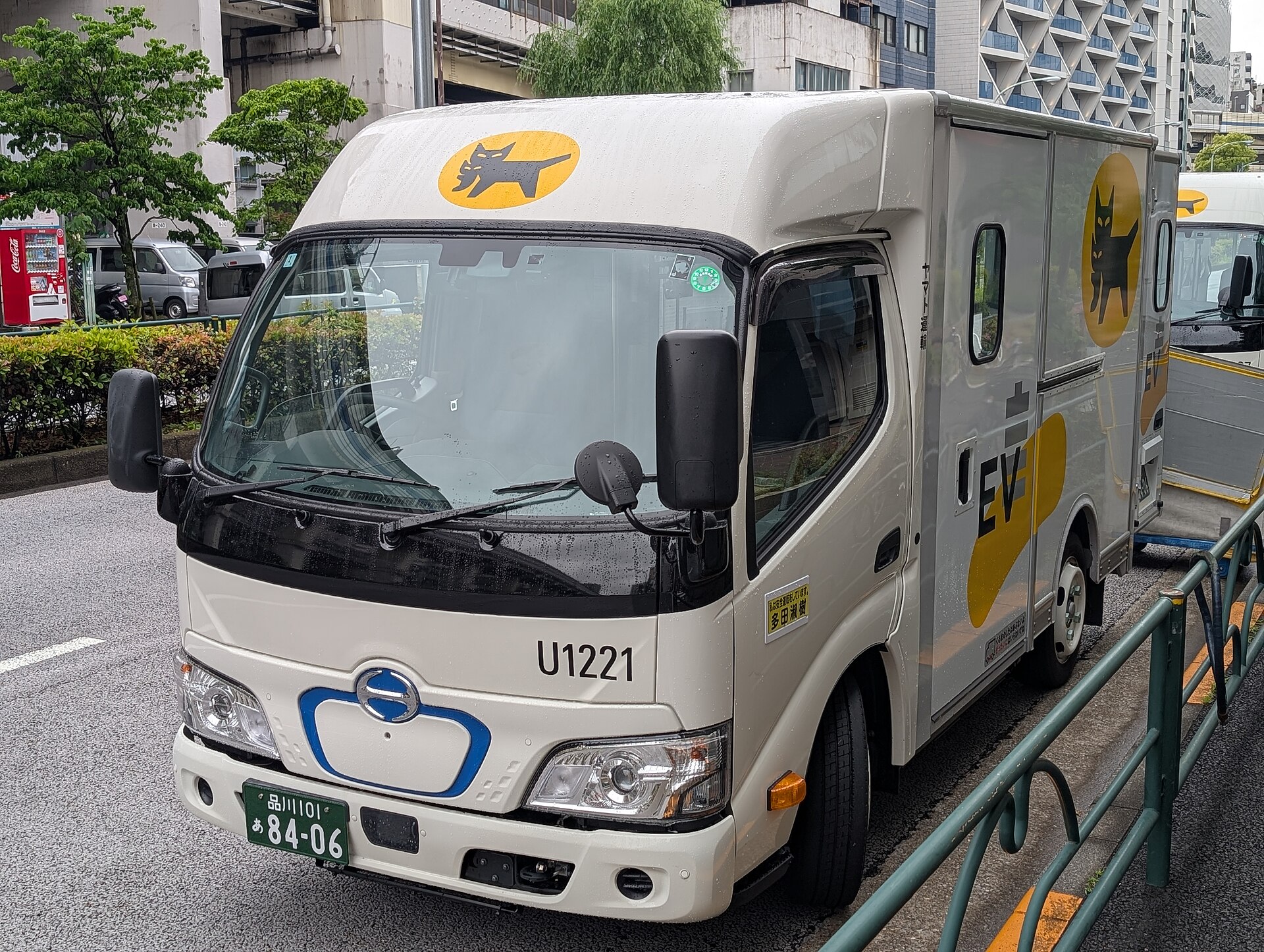
Cover photo: Syced/ Wikimedia Commons / CC0. The image size has been adjusted for display purposes.
Masao Ogura|Manager who developed TA-Q-BIN
A 3-page feature based on public historical records
Are small parcels necessarily a disadvantage?
If it's a large package, you can carry a lot at once. Household luggage is small, and the destinations and times vary. If you compare the same way of creating work, it is natural that the latter would seem to be at a disadvantage. Masao Ogura's challenge was to change the premise of that comparison.
Yamato's 100th anniversary history notes that Ogura sought new business in the face of delays in long-distance transportation and the oil crisis. In 1973, in New York, an experience in which he saw cars from the same transportation company driving in close proximity led him to pay attention to regional pickup and delivery density.[1]
Even if the number of parcels per item is small, if many requests are gathered in a nearby area, the distance traveled for each item can be reduced. This is not just a mindset to cherish small items. This is a business design issue that changes the units in which efficiency is calculated.
However, the density will not be completed on the day of opening. While there is little cargo, the burden of preparing bases and vehicles comes first. If the number of users does not increase, it cannot be made convenient, and if it is not convenient, the number of users cannot increase. Because of this difficulty, it is not enough to simply explain that you have found an untapped market.
If we study Ogura's ideas, we cannot jump to the conclusion that we will accept customers with low profits unconditionally. As the number of customers increases, where does work become more efficient and where does it become more crowded? It is important to think about what it will look like after it expands, and how to support the burden before that happens.
伝Interpreting YAMATO DENSHI
Rethinking the unit used to measure profitability.
While a single sale alone may be disadvantageous, the conditions may change depending on the region, time zone, and group of customers. On the other hand, there are some processes that become more burdensome as the number of cases increases. The starting point is to look at the relationship between quantity and efficiency separately for each process.